
The Annapurna Base Camp permit cost sits at the center of every trekker's pre-trip budget. If you are an international trekker willing to trek to Nepal, you need two official permits .
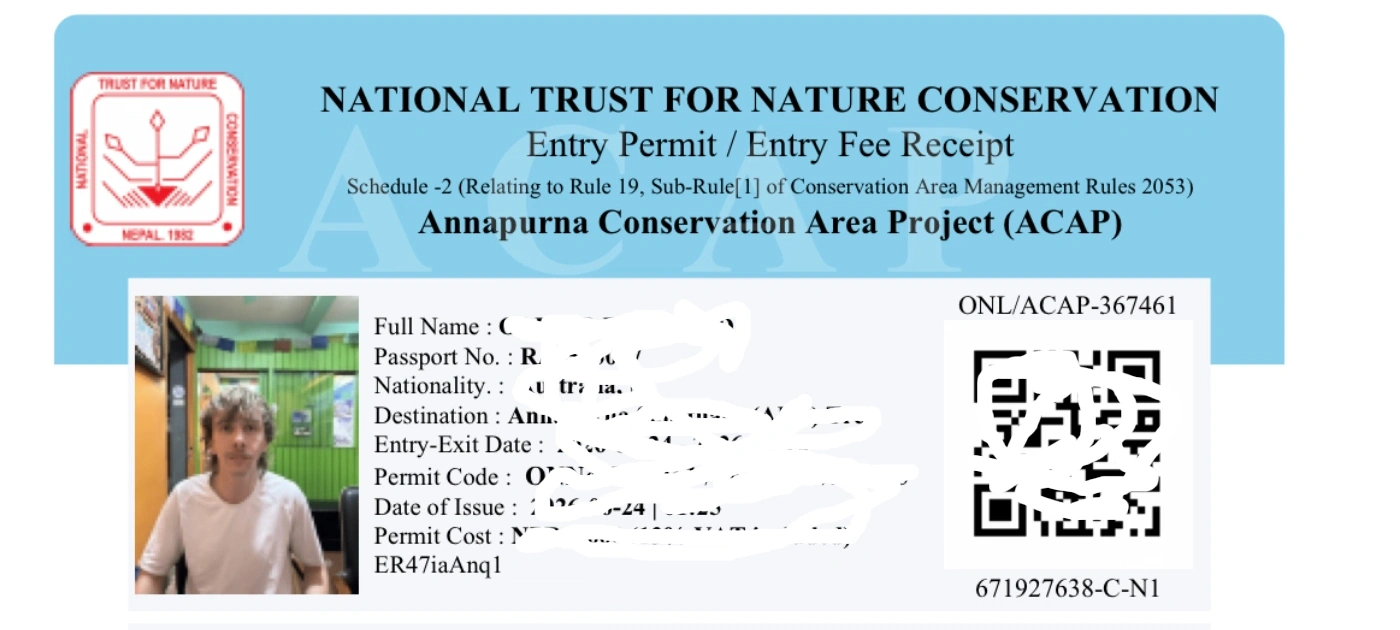
Annapurna Trek Permits & Insurance Explained (2026 Update)

You also need a valid travel insurance before they set foot on the Annapurna trail.
These rules are not red tape. In fact, they protect you, fund the trails you walk on, and support the mountain or say local communities along the route.
This guide breaks down each permit step by step. You will know the exact 2026 fees, where to apply, and what documents you need for getting the Annapurna permits .
You will also learn about the insurance rules, coverage limits, and trusted providers for high-altitude trekking.
The permit fees generated from Annapurna region helps the locals in trail repairs, bridge maintenance, and wildlife protection in this region.
Not just permits you need to have but in fact you should also hire a guide for your trekking .
A government rule from 2023 has made this rule that every foreign trekker needs to hire a registered guide. This is for the safety of protecting the international trekkers.
This guide will make you know about the TIMS card, the ACAP permit, restricted area add-ons, and the insurance coverage you need before you book your trek.
Why do trekkers need permits for Annapurna Trekking ?
Annapurna sits inside Nepal's largest protected area, the Annapurna Conservation Area. This zone covers high peaks, deep valleys, and dozens of mountain villages.
The government created this area to protect the land and the people who live there. Your permit fees go straight into that protection work. Permit money pays for trail repairs, bridge maintenance, and clean water projects in the region.
It also funds ranger patrols that protect local wildlife, like the snow leopard and the Himalayan tahr.
When you buy a permit, you help keep these trails open for the next trekker too.
Changed Rules for Permits (2023)
Nepal added a new rule in 2023. It is mandatory for every foreign trekker to hire a registered guide from TAAN association for treks in major regions in Nepal. This includes Annapurna too .
This rule keeps trekkers safer on remote trails and supports local guiding jobs.
With the purpose of these permits clear, the next step is knowing exactly which ones apply to your trek.
2026 Update changes for Annapurna Base Camp & Circuit Treks
Important Note for 2026:
Nepal’s trekking regulations keep evolving every year. This is for the safety, conservation, and tourism management of the trekkers .
While the core requirements remain similar to recent years, enforcement practices on the trail have become more consistent.
Make sure you always be updated with the details upon arrival, as rules can be updated locally.
Major 2026 Highlights:
Guide Requirement:
The guide requirement is mandatory for all foreign trekkers which has been enforced since April 2023.
You must trek with a government registered, licensed guide from NATHM.
Himalayan Spirit Adventure is always happy to help with logistics.
Solo independent trekking is not permitted in the Annapurna region.
ACAP Permit:
Remains the primary and strictly enforced permit for the entire Annapurna Conservation Area (including Annapurna Base Camp and most Circuit routes).
Restricted Areas:
For the restricted areas like Nar-Phu Valley and Upper Mustang , they still require additional Restricted Area Permits (RAP) and a licensed guide to trek Annapurna .
Insurance:
Insurance is strongly recommended and is also required by Himalayan Spirit Adventure for permit processing.
This insurance must cover high-altitude trekking and emergency helicopter evacuation of minimum $10,000–$20,000+ coverage .
2026 Permit Requirements Comparison Table
| Permit Type | Required for ABC Trek? | Cost (Foreigners, 2026) | Validity | Notes / Enforcement |
| ACAP Permit | Yes (Mandatory) | $23 USD (NPR 3,000) | Unlimited days | Primary permit. Checked at all major checkpoints (Birethanti, Chhomrong, etc.). Fund conservation. |
| TIMS Card | Often processed but not strictly enforced | $8–15 USD (NPR 1,000-2,000) | Per trek | Group rate lower. Many trekkers complete ABC without issues even if not obtained. |
| Restricted Area Permit (RAP) | Only for Nar-Phu or Upper Mustang extensions | $50–$100+ per week | By duration | Minimum guide required. Solo not allowed. |
| Travel Insurance | Strongly Recommended / Agency Required | $100–$150+ | Trip duration | Must cover above 5,000m altitude + helicopter rescue. Proof often needed for permits. |
Permits you need to trek Annapurna in 2026
Annapurna trekkers need two main permits and sometimes a third, depending on the route.
Note : Most trekkers on the main Annapurna routes only need the TIMS card and the ACAP permit.
The restricted area add-on only applies if your route includes Nar-Phu or Upper Mustang.
Below you can see what permits you need for Annapurna Region :
TIMS Card for Annapurna Trekking
The TIMS card is the abbreviated form for Trekkers' Information Management System. This permit tracks your safety on the trail.
Local authorities use this card to log your route and check in on you at registration points.
Nepal made this card compulsory for both guided and group treks.
You can get your TIMS card in two cities. One is you can get it from Kathmandu. Visit the TAAN office on Saat Ghumti Road in Thamel.
The next is in Pokhara. You can visit the Nepal Tourism Board office at Damside.
Documents Required for Permits
You need three documents for your application. Bring a copy of your passport, two passport-size photos, and proof of your travel insurance.
Without insurance proof, the office may not issue your card.
The TIMS card costs $20 for foreign trekkers in 2026. You can pay this fee in cash, or by e-payment where the office offers it. Once you have your TIMS card, the next permit on your list is the ACAP.
ACAP ( Annapurna Conservation Area Permit )
ACAP is another important permit for Annapurna Region.
The ACAP permit funds the conservation work that keeps Annapurna's trails and villages running. This permit is reliable for waste management projects and eco-friendly programs across the region.
Every trekker entering the Annapurna Conservation Area must carry this permit. You can get the ACAP permit from the NTNC office.
In Kathmandu, this office sits in Khumaltar.
In Pokhara, you'll find it near Damside, close to the Nepal Tourism Board.
The 2026 fee for foreign trekkers is $30. SAARC citizens pay NPR 1,000. Children under ten years old can trek for free.
To apply for this permit , bring a copy of your passport, two photos, and a filled application form. Once issued, your permit stays valid for unlimited days on the trail.
This works well for slower itineraries or multi-region routes. You'll need to show this permit at several checkpoints along the trail.
These checkpoints include Birethanti, Chhomrong, Jomsom, and Manang. Staff at each post will stamp your permit, so carry the original copy at all times. A photo on your phone will not work at these checkpoints.
With your TIMS card and ACAP permit in hand, most standard Annapurna routes are covered.
Once you understand the above permit requirements, you can explore our 7 Days Annapurna Base Camp Trek for a complete itinerary and trip details.
If your trek includes a restricted side route, though, you'll need one more permit.
Check out below :
Restricted Area Permits for side routes
Some Annapurna side routes need an extra permit apart from the TIMS card and ACAP. Nar-Phu and Upper Mustang fall into this restricted category.
Nepal's government limits access to these areas to protect their culture and fragile land.
So, in order to trek these routes, you need a government-registered guide. You also need a group of at least two foreign trekkers.
You might not know this but for your ease, solo trekkers cannot get this permit, even with a guide.
The cost for this permit depends on the season. From September to November, the fee runs about $70 per week.
In other months, the fee drops to about $50 per week.
Confused how to apply ?
What is the application process for Permits (2026) ?
Getting your permits is not that difficult of a task. It can be completed in five simple steps. The time almost takes an hour.
- Visit an official permit office or an authorized trekking agency.
- Fill out the permit form with your trek route and travel dates.
- Provide your passport copy, photos, and insurance details.
- Pay the permit fees in USD or NPR.
- Collect your stamped permits and keep the originals with you on the trail.
Note : Himalayan Spirit Adventure handles this entire process for you.
This saves you your time to visit the permit office and removes the hassle of paperworks. Even so, it helps to know what each step involves before you arrive in Nepal.
Now that you know how to apply, here are a few rules trekkers often miss:
The Most Common Permit Mistakes Trekkers Should Avoid
A few permit rules catch trekkers off guard each year. But life gets easier if you know them ahead of time. It saves your stress on the trail.
Since 2023, Nepal no longer issues solo permits for Annapurna. You must trek with a registered guide affiliated with TAAN.
Digital copies of your permits will not work at checkpoints, either.
Staff need to see and stamp a printed original.
So, keep it safe.
Losing your permit creates extra cost and delay. You'll need to pay a fine and a re-issuance fee to replace it. Keep your permits in a dry, secure spot, like a sealed pouch in your daypack.
One more detail trips up some trekkers. Always use the same passport for your permit application and your visa entry into Nepal.
A mismatch between the two can cause delays at checkpoints.
With your permits sorted, the next piece of required preparation is travel insurance.
Trekking Insurance Requirements for Nepal Treks
Travel insurance is not optional for an Annapurna trek.
You can consider it as a mandatory document . Most trekking agencies require proof of insurance before they process your permits. This rule exists for a clear reason: mountain rescue and medical care cost far more than most trekkers expect.
A solid policy covers three main needs.
It pays for helicopter rescue if you get hurt or sick at altitude. It covers medical treatment at hospitals in Pokhara or Kathmandu. It can also cover trip cancellation, lost baggage, or travel delays, though these are optional add-ons.
The table below shows the coverage limits we recommend for an Annapurna trek.
| Coverage Item | Minimum Limit | Notes |
| Emergency Evacuation | $10,000+ | Covers helicopter rescue from the trail |
| Medical Treatment | $20,000+ | Covers hospital care in Pokhara or Kathmandu |
| Trip Cancellation |
Optional |
Useful during the monsoon season |
| Baggage & Delay |
Optional |
Adds extra convenience |
A few insurers stand out for trekking coverage. Some of them are World Nomads, Allianz, and True Traveller all offer trekking policies.
Before you buy you need to confirm if the policy covers activity above 5,000 meters. Many standard travel policies stop coverage well below Annapurna Base Camp's altitude. Local Nepali insurance plans offer limited coverage for foreign trekkers. For this reason, most trekkers buy an international policy from their home country instead.
An international plan gives you wider coverage and a more reliable claims process if anything goes wrong.
Once your insurance is in place, you can budget the full cost of your permits and coverage together.
Permit Cost Summary (2026)
Check out the simple summary of what you'll spend on permits and insurance for Annapurna trek.
| Item | Foreigners (USD) | SAARC (NPR ) | Validity |
| TIMS Card | $20 | NPR 2,000 | Single trek |
| ACAP Permit | $30 | NPR 1,000 | Unlimited days |
| Insurance | $100-150 | Varies | Trip duration |
Contact Himalayan Spirit Adventure for more accurate pricing .
Getting Assistance With Trekking Permits
A few trusted sources can confirm permit rules before you travel.
The Nepal Tourism Board's official website, ntb.gov.np, posts current fees and rules. TAAN offices in both Pokhara and Kathmandu can also confirm requirements in person.
One quick tip can save you a wasted trip.
Arrive at the NTB office in Pokhara before 3 p.m. since permit desks often close early in the afternoon.
Common Permit Questions
Can Permits be issued on the spot?
Yes. You can apply for both the TIMS card and ACAP permit the same day in Kathmandu or from Pokhara.
However, the permits are not issued on Public Holidays. So, make sure you are at the right timeframe to get your permits.
Are Permits Mandatory for Poon Hill and Mardi Himal?
Both routes sit inside the Annapurna Conservation Area. So, yes you need the ACAP permit and the TIMS card for Poon Hill or Mardi Himal .
Are Trekking permits required for Nepali Nationals?
Nepali citizens don't need these permits, but they should carry valid ID and check in at local posts.
Do children need trekking permits for Annapurna?
Children under 10 years old do not require ACAP permit fees.
But if you are those aged 10 and above, you require the standard trekking permits. Always check the latest regulations before your trek to Annapurna.
Can you trek with only a digital permit?
No it is not accepted . Checkpoint staff need printed originals. Carry physical copies with you at all times on the trail.
Need Help? Call Us+977 9851112259orChat with us on WhatsApp
Latest Travel Blogs

Need Help? Call Us+977 9851112259